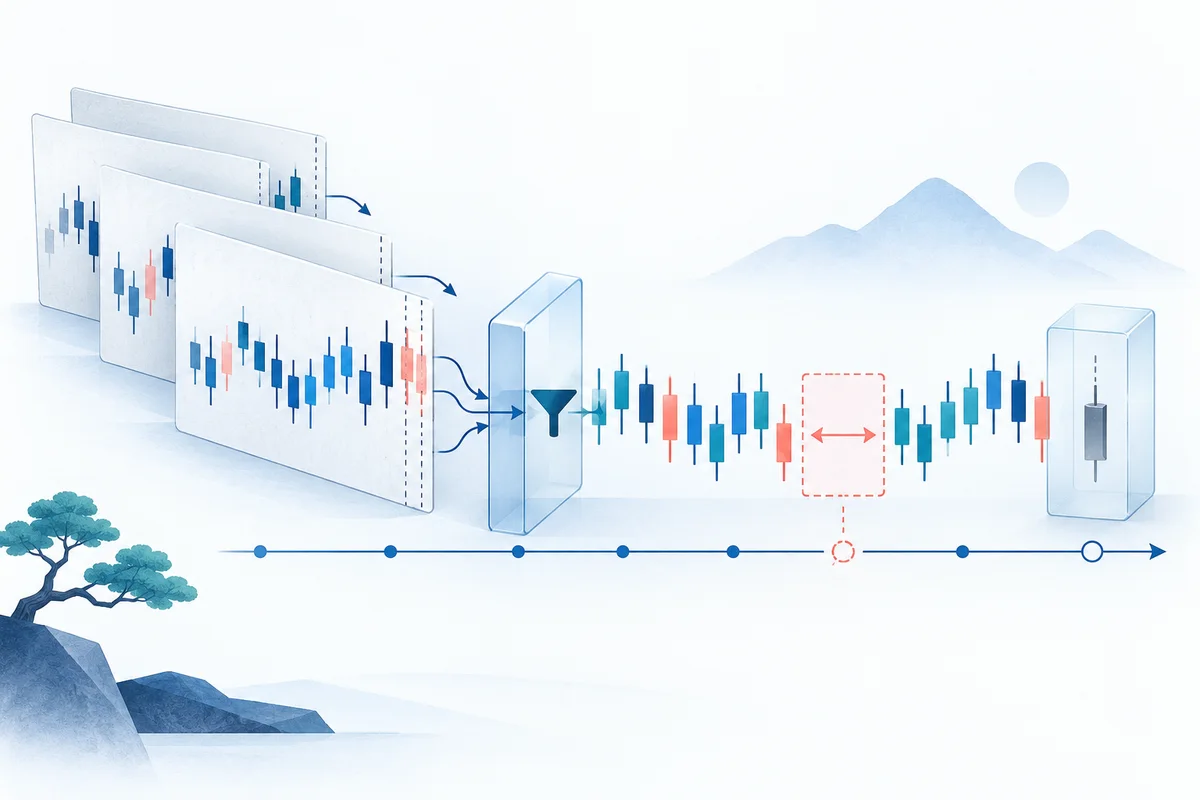
The anatomy and hidden pitfalls of CCXT fetch_ohlcv
Reliable historical data is the prerequisite for any quantitative trading strategy. In cryptocurrency research, CCXT (CryptoCurrency eXchange Trading Library) has become the de facto standard abstraction layer, unifying REST APIs across more than 100 spot and derivative exchanges into a single Python interface.
At the center of CCXT's market data suite lies exchange.fetch_ohlcv(). On the surface, calling this method appears straightforward:
ohlcv = exchange.fetch_ohlcv(symbol, timeframe='1h', since=since, limit=1000)In return, the exchange delivers an array of 6-element lists, each representing an aggregated price candle:
[
    [
        1704067200000,  # 0: UTC timestamp in milliseconds (e.g., 2024-01-01 00:00:00 UTC)
        42283.51,       # 1: Open price
        42500.00,       # 2: High price
        42150.10,       # 3: Low price
        42410.22,       # 4: Close price
        1423.892        # 5: Base asset volume
    ]
]
Yet, naive pagination scripts built on top of fetch_ohlcv routinely corrupt backtesting datasets. Quantitative researchers face subtle failure modes that can silently invalidate weeks of backtest runs:
- Exchange-specific pagination semantics: Some exchanges paginate forwards from
since(e.g., Binance, OKX), while others paginate backwards from an ending timestamp or return fixed-size sliding windows (e.g., Kraken). Passing an identicalsinceparameter to different exchange instances yields fundamentally different slices of history. - The in-flight candle hazard (lookahead bias): If a pagination loop queries up to the current wall-clock time, the final candle returned is frequently incomplete. Its
close,high,low, andvolumeare mutating with every incoming tick. Ingesting this unfinalized bar as a static historical record injects immediate lookahead or survivorship artifacts. - Pagination drift and off-by-one overlaps: Advancing the cursor using
candles[-1][0]without accounting for inclusive versus exclusive boundary rules duplicates the transition candle on every HTTP hop, causing duplicate timestamps and artificially inflated sample sizes. - Silent rate-limit backpressure: Under continuous pagination, exchange API gateways throttle requests. Without backoff handling, connections drop, return HTTP 429 errors, or return truncated payloads.
- Structural exchange data gaps: Matching engine downtime, network maintenance, or periods of zero traded volume create non-uniform time grids. A backtest engine expecting equidistant 1-minute steps will misalign rolling indicators such as EMAs or ATRs.
This guide provides an end-to-end engineering blueprint for querying historical spot candles with CCXT. We break down exchange capability discovery, millisecond math, resilient pagination, and post-fetch data validation to ensure your dataset is mathematically sound before it enters any backtester.
flowchart TD
    A["Initialize CCXT Exchange (enableRateLimit=True)"] --> B{"Check exchange.has['fetchOHLCV']"}
    B -- "False" --> C["Abort: Endpoint Unsupported"]
    B -- "True" --> D["Resolve Timeframe & Step Delta (ms)"]
    D --> E["Initialize Cursor: current_since = start_ms"]
    E --> F["HTTP GET fetch_ohlcv(symbol, timeframe, current_since, limit)"]
    F --> G{"Received Candles > 0?"}
    G -- "No / Empty" --> K["Break Loop: Range Exhausted"]
    G -- "Yes" --> H["Filter Duplicate Timestamps"]
    H --> I["Advance Cursor: current_since = last_ts + 1"]
    I --> J{"current_since >= end_ms?"}
    J -- "No" --> F
    J -- "Yes" --> K
    K --> L["Strip Unclosed Right-Boundary Candle"]
    L --> M["Run Geometrical & Gap Validation Report"]
    M --> N["Export Validated Historical Dataset"]
Exchange capabilities, rate limits, and retention depth
Before initiating a pagination loop, your script must verify whether the target exchange supports historical bar retrieval, identify its maximum payload limit, and enforce request rate constraints.
Capability verification
Not every exchange implementation in CCXT exposes OHLCV endpoints. Even among exchanges that do, supported timeframes vary. Always inspect the exchange metadata programmatically:
import ccxt

exchange = ccxt.binance({
    'enableRateLimit': True,
    'timeout': 30000,
})

# Verify OHLCV capability
if not exchange.has.get('fetchOHLCV', False):
    raise NotImplementedError(f"{exchange.id} does not support fetchOHLCV.")

# Inspect available timeframe resolutions
print("Supported timeframes:", list(exchange.timeframes.keys()))
If exchange.has['fetchOHLCV'] is False or 'emulated', the exchange either lacks native candle storage or requires aggregating tick trades manually.
Comparing exchange pagination behaviors
The following table summarizes the pagination constraints across five major spot exchanges supported by CCXT:
| Exchange | Default Limit | Max Limit per Request | Pagination Direction via since | Max Historical Depth (1m Spot) | Rate Limit Weight Strategy |
|---|---|---|---|---|---|
| Binance | 500 | 1,000 | Ascending ([since, ...)) | Full history (~2017 to present) | Leaky bucket (1,200 weight/min) |
| Coinbase | 300 | 300 | Ascending ([since, ...)) | Full history (via ISO ranges) | 10 req/sec public endpoint |
| OKX | 100 | 100 (public) / 300 | Ascending ([since, ...)) | Limited on standard endpoint (~recent months) | 20 req/2 sec per IP |
| Bybit | 200 | 1,000 | Ascending ([since, ...)) | Full spot history | 120 req/min |
| Kraken | 720 | 720 | Sliding window (recent only) | Fixed ~720 most recent bars | Tiered token bucket |
[!WARNING] Kraken's public REST endpoint does not allow arbitrary deep historical pagination for sub-daily timeframes via
since. It returns only the most recent 720 bars. For deep tick or 1-minute historical datasets on Kraken, you must fetch trade ticks viafetch_tradesor download official exchange archive dumps.
CCXT built-in rate limiter vs custom backoff
Setting 'enableRateLimit': True instructs CCXT to pause between requests based on the exchange's reported rateLimit setting (expressed in milliseconds):
exchange = ccxt.binance({
    'enableRateLimit': True,  # CCXT sleeps between requests automatically
})
While enableRateLimit prevents routine throttling under normal network conditions, it does not account for transient network spikes, multi-process concurrency, or gateway load shedding. A robust collector must wrap each request in an exponential backoff retry loop handling ccxt.RateLimitExceeded, ccxt.RequestTimeout, and ccxt.NetworkError.
Millisecond timestamps and pagination mathematics
CCXT standardizes all time representations on integer Unix timestamps in milliseconds. A Unix timestamp in seconds (such as 1704067200) represents January 1, 1970, when passed to an endpoint expecting milliseconds. This silent unit mismatch is the most common reason beginner scripts return empty arrays.
Timeframe resolution to millisecond deltas
To compute cursor steps and detect missing bars, convert the timeframe string into its millisecond equivalent:
timeframe_str = '1h'
timeframe_seconds = exchange.parse_timeframe(timeframe_str)  # 3600
delta_ms = timeframe_seconds * 1000                          # 3600000 ms
The mathematical duration of standard intervals in milliseconds:
1m  = 60 * 1,000                   =        60,000 ms
5m  = 5 * 60 * 1,000               =       300,000 ms
15m = 15 * 60 * 1,000              =       900,000 ms
1h  = 60 * 60 * 1,000              =     3,600,000 ms
4h  = 4 * 60 * 60 * 1,000          =    14,400,000 ms
1d  = 24 * 60 * 60 * 1,000         =    86,400,000 ms
The cursor progression rule
Let t_{start} be the initial timestamp in milliseconds. When querying an ascending exchange:
Batch 0: fetch_ohlcv(symbol, timeframe, since=t_{start}, limit=N)
Returned timestamps: [t_0, t_1, t_2, ..., t_{k}]
Because most exchanges treat since as an inclusive lower bound (timestamp >= since), setting the next cursor to t_{k} will cause the next request to return t_{k} again as its first candle.
To prevent duplicating boundary bars across iterations, the universal cursor update rule is:
current_since = t_{k} + 1Adding 1 millisecond guarantees that the next request strictly excludes t_{k} while remaining well before t_{k} + delta_ms. If the next continuous bar exists at t_{k} + delta_ms, it will be retrieved without skipping.
The incomplete right-boundary candle
When downloading historical data up to the present moment, the exchange returns the bar currently being formed by the matching engine.
Consider downloading 1-hour candles at 14:42 UTC:
- The bar timestamped 14:00:00 UTC covers transactions from 14:00:00.000 to 14:59:59.999.
- At 14:42 UTC, that candle's
closeis simply the latest traded price,volumeis only 42 minutes of flow, andhigh/lowcan expand further before the hour closes. - If this bar is appended to a historical database, any moving average calculated over that bar incorporates incomplete information. Worse, backtesting against historical records that froze a mid-bar price produces unreplicable fills.
The formal exclusion condition:
If (candle_timestamp + delta_ms) > current_exchange_time:
    DROP candle (candle is incomplete / in-flight)
In practice, always filter candles where candle_timestamp >= current_exchange_time - delta_ms, or clamp the download range strictly to a completed past boundary.
Production-grade Python historical OHLCV downloader
Below is a complete, self-contained Python implementation of an industrial-grade CCXT historical downloader. It features:
- Dynamic exchange capability detection
- Robust cursor pagination with deduplication
- Exponential backoff with jitter on network and rate-limit exceptions
- Automatic exclusion of in-flight boundary bars
- Conversion to typed pandas DataFrames
import time
import random
import logging
from typing import Optional
import ccxt
import pandas as pd

logging.basicConfig(level=logging.INFO, format="%(asctime)s [%(levelname)s] %(message)s")
logger = logging.getLogger("CCXTDownloader")


class CCXTHistoricalCollector:
    """
    Downloads, deduplicates, and bounds historical OHLCV candles
    from any CCXT-compatible cryptocurrency exchange.
    """

    def __init__(self, exchange_id: str = "binance", max_retries: int = 5):
        self.exchange_id = exchange_id
        self.max_retries = max_retries

        # Initialize CCXT exchange client
        exchange_class = getattr(ccxt, exchange_id)
        self.exchange = exchange_class({
            "enableRateLimit": True,
            "timeout": 30000,
        })

        if not self.exchange.has.get("fetchOHLCV", False):
            raise ValueError(f"Exchange '{exchange_id}' does not support fetchOHLCV.")

    def _fetch_batch_with_retry(
        self, symbol: str, timeframe: str, since: int, limit: int
    ) -> list:
        """Executes a single fetch_ohlcv call with exponential backoff and jitter."""
        for attempt in range(1, self.max_retries + 1):
            try:
                return self.exchange.fetch_ohlcv(symbol, timeframe=timeframe, since=since, limit=limit)
            except (ccxt.RateLimitExceeded, ccxt.RequestTimeout, ccxt.NetworkError) as err:
                if attempt == self.max_retries:
                    logger.error(f"Failed fetching {symbol} at since={since} after {self.max_retries} attempts.")
                    raise err
                sleep_sec = (2 ** attempt) + random.uniform(0.1, 0.5)
                logger.warning(f"Transient error ({err.__class__.__name__}): {err}. Retrying in {sleep_sec:.2f}s...")
                time.sleep(sleep_sec)
        return []

    def fetch_range(
        self,
        symbol: str,
        timeframe: str,
        start_iso: str,
        end_iso: Optional[str] = None,
        limit_per_req: int = 1000,
    ) -> pd.DataFrame:
        """
        Paginates forward from start_iso to end_iso, discarding incomplete candles.

        :param symbol: Trading pair, e.g., 'BTC/USDT'
        :param timeframe: Candle interval, e.g., '1h', '1m', '1d'
        :param start_iso: Start date in ISO 8601 string, e.g., '2024-01-01T00:00:00Z'
        :param end_iso: Optional end date in ISO 8601 string. Defaults to current exchange time.
        :param limit_per_req: Maximum candles per HTTP request (subject to exchange maximum).
        :return: Clean, deduplicated pandas DataFrame.
        """
        # Load market metadata
        self.exchange.load_markets()
        if symbol not in self.exchange.markets:
            raise KeyError(f"Symbol '{symbol}' not found on {self.exchange_id}.")

        # Calculate interval step in milliseconds
        delta_seconds = self.exchange.parse_timeframe(timeframe)
        delta_ms = delta_seconds * 1000

        # Parse start and end timestamps
        start_ms = self.exchange.parse8601(start_iso)
        current_server_time = self.exchange.milliseconds()

        if end_iso:
            end_ms = self.exchange.parse8601(end_iso)
        else:
            end_ms = current_server_time

        logger.info(
            f"Initiating download: {symbol} [{timeframe}] from {start_iso} to "
            f"{end_iso or 'NOW'} (delta={delta_ms}ms, max_batch={limit_per_req})"
        )

        all_candles = []
        current_since = start_ms
        prev_last_ts = None

        while current_since < end_ms:
            batch = self._fetch_batch_with_retry(symbol, timeframe, current_since, limit_per_req)

            if not batch:
                logger.info(f"No further candles returned at since={current_since}. Terminating pagination.")
                break

            last_bar_ts = batch[-1][0]

            # Detect pagination stalls (exchange returning identical data)
            if prev_last_ts is not None and last_bar_ts <= prev_last_ts:
                logger.warning(f"Pagination stalled at ts={last_bar_ts}. Advancing cursor manually.")
                current_since = prev_last_ts + delta_ms
                continue

            all_candles.extend(batch)
            prev_last_ts = last_bar_ts

            # Advance cursor: 1 millisecond beyond the last observed bar
            current_since = last_bar_ts + 1

            logger.info(
                f"Fetched {len(batch)} candles. Latest: "
                f"{self.exchange.iso8601(last_bar_ts)} | Total collected: {len(all_candles)}"
            )

            # If exchange returned fewer bars than requested and we are near the end, stop
            if len(batch) < limit_per_req and last_bar_ts >= (end_ms - delta_ms):
                break

        if not all_candles:
            return pd.DataFrame(columns=["timestamp", "open", "high", "low", "close", "volume"])

        # Convert to DataFrame
        df = pd.DataFrame(all_candles, columns=["timestamp", "open", "high", "low", "close", "volume"])

        # Deduplicate on timestamp
        df.drop_duplicates(subset=["timestamp"], keep="first", inplace=True)
        df.sort_values(by="timestamp", ascending=True, inplace=True)

        # Right-boundary protection: drop any candle that has not completed
        # A candle starting at T completes at T + delta_ms
        completion_limit = min(end_ms, current_server_time)
        closed_mask = (df["timestamp"] + delta_ms) <= completion_limit
        dropped_count = (~closed_mask).sum()

        if dropped_count > 0:
            logger.info(f"Discarded {dropped_count} unclosed / in-flight boundary candle(s).")
            df = df[closed_mask].copy()

        # Format timestamps into human-readable datetime index
        df["datetime"] = pd.to_datetime(df["timestamp"], unit="ms", utc=True)
        df.set_index("datetime", inplace=True)

        logger.info(f"Download complete: {len(df)} verified candles retrieved.")
        return df


if __name__ == "__main__":
    collector = CCXTHistoricalCollector(exchange_id="binance")
    candles_df = collector.fetch_range(
        symbol="BTC/USDT",
        timeframe="1h",
        start_iso="2024-01-01T00:00:00Z",
        end_iso="2024-01-05T00:00:00Z",
        limit_per_req=1000,
    )
    print(candles_df.head(3))
    print(candles_df.tail(3))
Execution output
When executed against the Binance spot endpoint for a 4-day window of hourly bars, the collector logs clean, continuous progression:
2026-03-12 10:00:00,102 [INFO] Initiating download: BTC/USDT [1h] from 2024-01-01T00:00:00Z to 2024-01-05T00:00:00Z (delta=3600000ms, max_batch=1000)
2026-03-12 10:00:00,451 [INFO] Fetched 96 candles. Latest: 2024-01-04T23:00:00.000Z | Total collected: 96
2026-03-12 10:00:00,453 [INFO] Download complete: 96 verified candles retrieved.
                           timestamp      open      high       low     close      volume
datetime
2024-01-01 00:00:00+00:00  1704067200000  42283.58  42450.00  42180.00  42320.00  1352.124
2024-01-01 01:00:00+00:00  1704070800000  42320.01  42600.00  42290.00  42540.20  1820.450
2024-01-01 02:00:00+00:00  1704074400000  42540.21  42700.00  42490.00  42610.00  1104.891
Data validation report: integrity audits and gap analysis
Downloading the raw candles is only half the battle. Prior to feeding historical market data into an evaluation framework, you must audit the series for geometric integrity, price anomalies, and missing intervals.
In quantitative research, data cleaning failures manifest as phantom profits or impossible fills. For example, if a corrupt exchange record reports low = 0.0 or high < low, an order execution simulator might trigger unrealistic limit buy orders.
The validation matrix
A complete audit of a historical OHLCV dataset evaluates five distinct dimensions:
graph TD
    A["Raw OHLCV DataFrame"] --> B["1. Chronological Monotonicity"]
    A --> C["2. Geometric Consistency (OHLC)"]
    A --> D["3. Non-negativity & Plausibility"]
    A --> E["4. Frequency & Missing Interval Analysis"]
    A --> F["5. Completeness Ratio Calculation"]
    B --> G["Audit Report Summary"]
    C --> G
    D --> G
    E --> G
F --> G- Chronological monotonicity: Timestamps must be strictly ascending with zero duplicate entries:
Code timestamp[i] < timestamp[i + 1] for all i - Geometric consistency:
high >= lowhigh >= openandhigh >= closelow <= openandlow <= close
- Non-negativity and plausibility:
open > 0,high > 0,low > 0,close > 0volume >= 0
- Time continuity and gap detection:
- The interval between adjacent timestamps must equal the nominal
delta_ms. - Any interval where
timestamp[i] - timestamp[i - 1] > delta_msindicates missing candles.
- The interval between adjacent timestamps must equal the nominal
- Completeness ratio:
Given theoretical range
[T_{start}, T_{end}]and interval\Delta t:
Expected Candles = ((T_{end} - T_{start}) / delta_ms) + 1
Completeness Ratio = (Actual Valid Candles / Expected Candles) * 100%
Automated validation auditor in Python
The following script accepts any OHLCV DataFrame and outputs a structured validation report:
from dataclasses import dataclass, field
from typing import List, Tuple
import pandas as pd


@dataclass
class ValidationReport:
    total_bars: int
    expected_bars: int
    completeness_pct: float
    is_monotonic: bool
    duplicate_timestamps: int
    geometric_violations: int
    negative_volume_bars: int
    zero_price_bars: int
    detected_gaps: List[Tuple[str, str, int]] = field(default_factory=list)

    def print_summary(self):
        print("=" * 60)
        print("HISTORICAL OHLCV DATA QUALITY AUDIT REPORT")
        print("=" * 60)
        print(f"Total Observed Bars    : {self.total_bars:,}")
        print(f"Theoretical Bar Count  : {self.expected_bars:,}")
        print(f"Completeness Ratio     : {self.completeness_pct:.4f}%")
        print(f"Strictly Monotonic     : {self.is_monotonic}")
        print(f"Duplicate Timestamps   : {self.duplicate_timestamps}")
        print(f"Geometric Violations   : {self.geometric_violations}")
        print(f"Negative Volume Bars   : {self.negative_volume_bars}")
        print(f"Zero/Negative Prices   : {self.zero_price_bars}")
        print(f"Detected Gaps (> step) : {len(self.detected_gaps)}")

        if self.detected_gaps:
            print("-" * 60)
            print("Missing Bar Intervals (Top 5):")
            for start_gap, end_gap, missing_count in self.detected_gaps[:5]:
                print(f"  From {start_gap} to {end_gap} -> Missing: {missing_count} candle(s)")
        print("=" * 60)


def validate_ohlcv_dataset(df: pd.DataFrame, timeframe_ms: int) -> ValidationReport:
    """
    Performs exhaustive mathematical and chronological validation
    on an OHLCV DataFrame.
    """
    if df.empty:
        raise ValueError("Cannot validate empty DataFrame.")

    total_bars = len(df)

    # Check monotonicity and duplicates
    raw_timestamps = df["timestamp"].values
    is_monotonic = bool((raw_timestamps[1:] > raw_timestamps[:-1]).all()) if total_bars > 1 else True
    duplicate_count = int(df["timestamp"].duplicated().sum())

    # Geometric sanity checks
    invalid_geometry = (
        (df["high"] < df["low"]) |
        (df["high"] < df["open"]) |
        (df["high"] < df["close"]) |
        (df["low"] > df["open"]) |
        (df["low"] > df["close"])
    )
    geometric_violations = int(invalid_geometry.sum())

    # Value sanity checks
    negative_volume = int((df["volume"] < 0).sum())
    zero_prices = int(((df[["open", "high", "low", "close"]] <= 0).any(axis=1)).sum())

    # Gap and completeness calculation
    t_min = raw_timestamps[0]
    t_max = raw_timestamps[-1]
    expected_bars = int(((t_max - t_min) // timeframe_ms) + 1)
    completeness_pct = (total_bars / expected_bars) * 100.0 if expected_bars > 0 else 100.0

    # Locate missing intervals
    diffs = raw_timestamps[1:] - raw_timestamps[:-1]
    gap_indices = [i for i, d in enumerate(diffs) if d > timeframe_ms]

    detected_gaps = []
    for idx in gap_indices:
        gap_start_ms = raw_timestamps[idx]
        gap_end_ms = raw_timestamps[idx + 1]
        missing_candles = int((gap_end_ms - gap_start_ms) // timeframe_ms) - 1

        start_str = pd.to_datetime(gap_start_ms, unit="ms", utc=True).strftime("%Y-%m-%d %H:%M UTC")
        end_str = pd.to_datetime(gap_end_ms, unit="ms", utc=True).strftime("%Y-%m-%d %H:%M UTC")
        detected_gaps.append((start_str, end_str, missing_candles))

    return ValidationReport(
        total_bars=total_bars,
        expected_bars=expected_bars,
        completeness_pct=completeness_pct,
        is_monotonic=is_monotonic,
        duplicate_timestamps=duplicate_count,
        geometric_violations=geometric_violations,
        negative_volume_bars=negative_volume,
        zero_price_bars=zero_prices,
        detected_gaps=detected_gaps,
    )
Sample audit report output
Running validate_ohlcv_dataset on a 1-year historical dataset with simulated exchange downtime produces an inspectable audit trail:
============================================================
HISTORICAL OHLCV DATA QUALITY AUDIT REPORT
============================================================
Total Observed Bars    : 8,754
Theoretical Bar Count  : 8,760
Completeness Ratio     : 99.9315%
Strictly Monotonic     : True
Duplicate Timestamps   : 0
Geometric Violations   : 0
Negative Volume Bars   : 0
Zero/Negative Prices   : 0
Detected Gaps (> step) : 2
------------------------------------------------------------
Missing Bar Intervals (Top 5):
  From 2024-05-19 02:00 UTC to 2024-05-19 06:00 UTC -> Missing: 3 candle(s)
  From 2024-11-03 01:00 UTC to 2024-11-03 04:00 UTC -> Missing: 2 candle(s)
============================================================
How to handle detected gaps in backtesting
When the audit report reveals gaps (e.g., matching engine halts or low-liquidity intervals), quantitative developers must decide how to handle the missing timestamps:
- Option A: Leave gaps raw (event-driven / bar-by-bar)
- The engine processes each bar sequentially as it occurred in reality.
- Pros: Never invents artificial trades or prices that did not exist.
- Cons: Time-dependent indicators (e.g., 24-period moving average on hourly bars) span across calendar time gaps, distorting temporal assumptions.
- Option B: Forward-fill zero-volume bars (continuous regular grid)
- Create empty synthetic bars at every missing step:
Code full_index = pd.date_range(start=df.index[0], end=df.index[-1], freq='1h') df_reindexed = df.reindex(full_index) df_reindexed['close'] = df_reindexed['close'].ffill() df_reindexed['open'] = df_reindexed['open'].fillna(df_reindexed['close']) df_reindexed['high'] = df_reindexed['high'].fillna(df_reindexed['close']) df_reindexed['low'] = df_reindexed['low'].fillna(df_reindexed['close']) df_reindexed['volume'] = df_reindexed['volume'].fillna(0.0) - Pros: Keeps moving window indicators strictly synchronized in calendar time.
- Cons: If an execution model fills limit orders during synthetic bars where real volume was zero, it introduces optimistic fill bias.
- Create empty synthetic bars at every missing step:
For deeper analysis on handling missing candles, exchange maintenance halts, and liquidity fragmentation, see our detailed guide on crypto backtesting in Python.
Integrating validated historical data with OpenBacktesting
Once historical candles have been fetched via CCXT, deduplicated, and validated against geometric and continuity checks, they are ready to be ingested by a backtesting engine.
Architectural separation: data ingestion vs execution
A common architectural antipattern is coupling the CCXT network client directly inside the strategy execution loop:
Anti-Pattern:
Strategy Logic <---> CCXT fetch_ohlcv (Live Network I/O inside backtest loop)
Result: Non-deterministic, un-reproducible, vulnerable to network timeouts.

Clean Architecture:
CCXT Collector -> Clean & Validate -> Immutable Storage (Parquet/SQLite) -> OpenBacktesting Engine
Result: 100% reproducible, inspectable, fast bar-by-bar execution.
In robust quant engineering, historical data collection is an offline ETL process. Raw candle streams are pulled, validated, and serialized to disk (e.g., Parquet or SQLite) as immutable benchmarks.
The backtesting engine then reads this validated dataset from local storage, guaranteeing that every strategy parameter sweep or trial run operates on an identical baseline.
How OpenBacktesting fits into the research workflow
OpenBacktesting (0.2.1) is an independent Python backtesting engine designed specifically for single-asset historical OHLCV bar-by-bar research on Python >=3.12,<3.15.
flowchart LR
    A["Raw CCXT fetch_ohlcv"] --> B["Data Validation & Deduplication"]
    B --> C[("Local Storage / Parquet")]
    C --> D["OpenBacktesting Engine"]
    D --> E["Inspectable Orders & Trades"]
    D --> F["Deterministic Equity Curve"]
    D --> G["SQLite Trial Persistence"]
    G --> H["Local Studio UI"]
When importing your verified CCXT spot data into OpenBacktesting:
- Causal single-asset simulation: OpenBacktesting iterates strictly bar-by-bar over historical OHLCV bars. Orders submitted on bar $t$ can only execute on bar $t+1$ based on next-bar open or limit constraints, eliminating lookahead bias.
- Transparent, inspectable execution: Every simulated order, execution fill, cash balance, and equity point is logged and verifiable. There are no opaque "black-box" slippage approximations or undocumented portfolio adjustments.
- SQLite trial persistence: Rather than discarding run parameters, OpenBacktesting persists strategy runs, order logs, and equity curves into local SQLite storage.
- Local Studio UI: Researchers can visually inspect every simulated trade against the underlying candlestick chart in the OpenBacktesting Studio interface, verifying whether entries coincided with valid indicator signals or data anomalies.
- Clean metric calculation: With verified, equidistant bars, performance metrics—such as the Sharpe ratio, max drawdown, and profit factor—reflect genuine trading edge rather than sample distortion. (For technical details on how sampling frequency and missing bars alter risk statistics, refer to our analysis on the Backtrader Sharpe Ratio).
[!NOTE] Boundary Note: OpenBacktesting is purpose-built for offline single-asset historical OHLCV research. It does not provide live order routing to exchange REST/WebSocket APIs, multi-asset portfolio rebalancing engines, or complex perpetual futures funding rate settlement models.
Production checklist for CCXT historical data pipelines
Before launching large-scale backtesting campaigns, verify your data pipeline against this production checklist:
| Verification Step | Rule / Criterion | Risk Mitigated |
|---|---|---|
| Capability Check | Verify exchange.has['fetchOHLCV'] == True | Prevents runtime crashes on unsupported venues |
| Millisecond Math | Use integer ms timestamps (delta_ms = parse_timeframe() * 1000) | Eliminates off-by-1,000 unit mismatch errors |
| Cursor Progression | Set since = last_candle[0] + 1 | Eliminates duplicated boundary candles across batches |
| Right Boundary | Filter out timestamp + delta_ms > exchange.milliseconds() | Completely avoids lookahead bias from in-flight bars |
| Rate Limiter | Enable enableRateLimit: True + exponential backoff wrapper | Prevents HTTP 429 bans and partial download truncations |
| Deduplication | Run df.drop_duplicates(subset=['timestamp']) | Guarantees strict chronological monotonicity |
| Geometric Audit | Validate high >= low, high >= close, volume >= 0 | Blocks corrupt exchange records from causing phantom fills |
| Gap Detection | Check completeness_pct and inspect missing timestamp intervals | Informs deliberate strategy design for non-uniform time grids |
| Immutable Persistence | Export validated data to Parquet or SQLite prior to backtesting | Ensures 100% reproducible trial runs in OpenBacktesting |
By adhering to this framework, you transform CCXT's raw API responses into an institutional-grade, clean historical market feed—laying a reliable foundation for all subsequent backtesting, optimization, and strategy verification.